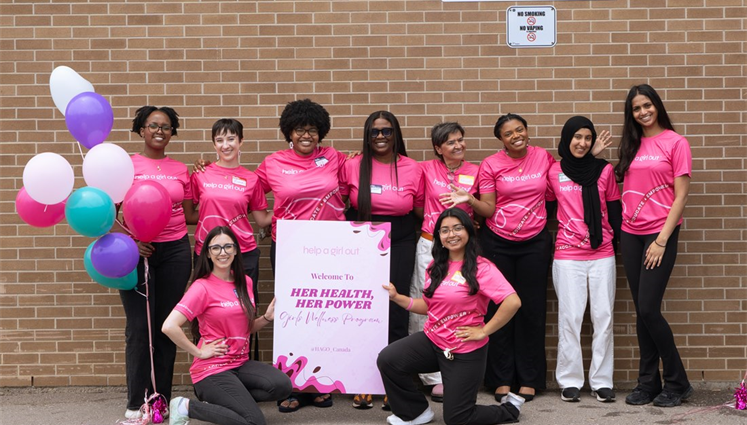
The Menstrual Equity Fund has provided free period products and menstrual health education to hundreds of communities from Labrador to British Columbia – and the organizations that delivered it, Help A Girl Out among them, are now asking Canadians for help to keep it alive.
Federal funding for the pilot is set to expire at the end of the 2026-2027 fiscal year. That is the reason six organizations have come together behind a single campaign at MenstrualEquity.ca, under the hashtags #PeriodEquityAction and #KeepMEFund.
Before we talk about what’s at risk, it’s worth noting what a few years of real investment have actually made possible.
What is the Menstrual Equity Fund?
The Menstrual Equity Fund began as a promise in Budget 2022 – $25 million over two years for a national pilot to increase access to menstrual products. It did not appear out of nowhere. It was the result of years of advocacy by student groups, youth advocates, and grassroots charities who continued to tell the same story: people in this country are missing school and work because they cannot afford a box of pads.
In September 2023, Women and Gender Equality Canada (WAGE) selected Food Banks Canada (FBC) to deliver the national pilot. Over 4 years, the program made strides with almost $80 million in funding allocated to FBC for product distribution. The pilot was built around two objectives: test a national approach to free product access in low-income communities, and increase knowledge of menstrual health, raise awareness, and reduce period stigma.
What Six Organizations Built Together
Food Banks Canada selected six menstrual equity organizations to work alongside them as Education and Awareness Partners. Together, the grassroots organizations (many youth-led) rose to the challenge, turning their passion and stories into impact.
The collective numbers speak for themselves. The collective has delivered 124 million period products to people across Canada, provided foundational menstrual health education to more than 70,000 people, and reached over 300 communities. Women and Gender Equality Canada reports nearly 400 pilot sites and more than 2,000 distribution locations in every province and territory, with over four million instances of menstrual product access, with participants who said they saved money and missed fewer days of school and work.
Here is who did the work.
Help a Girl Out, since incorporating in 2018, has distributed nearly 2 million period products across more than 350 Canadian cities, delivered over 19,000 three-month supply kits through the Period Product Support Program, and run more than 380 uterine and menstrual health education workshops since 2021, which has been powered by over 100 active volunteers and 80 partner organizations.
The Period Purse, founded in 2017, is Canada’s first registered menstrual equity charity. It has donated more than 6.6 million period products and educated over 13,000 people, while pushing menstrual health into public view. 56 cities have declared May 28 as Menstrual Health Day, and 70 landmarks have been lit red in recognition.
Moon Time Connections is Canada’s only national Indigenous-led menstrual equity organization. It began in 2017 as Moon Time Sisters, founded by Nicole White, a Métis woman from Saskatchewan, after she learned that students in remote communities were missing school for lack of products. It now works with close to 300 community programs in 192 northern communities and has shipped over 11 million products north, both disposables and reusables.
Monthly Dignity works across Québec in both official languages, delivering discussion-based workshops in shelters, women’s centres, schools, and community spaces. Its sessions cover menstrual basics, product options, menopause, and period poverty, and its team has built inclusive terminology glossaries and reusable-product guides that other organizations now use.
Free Periods Canada trains the trainers. Its free ME101 program — a 90-minute live workshop plus three self-paced courses — has trained 480 people across Canada through 50 workshops with 30 community partners, equipping teachers, counsellors, coaches, and youth workers to teach menstrual equity themselves.
Project AIM operates out of a barn on an organic farm in Agassiz, British Columbia, serving the Fraser Valley and Lower Mainland. Founded in 2020 by Miel Bernstein and Tiffany Francis, it is the only partner distributing incontinence products alongside menstrual products, reaching elders, people experiencing homelessness, and communities that almost no one else serves.
Indigenous-led, francophone, youth-founded, rural, educator-focused. Before 2023, most of these organizations were doing this work largely on their own. The Menstrual Equity Fund is what turned six separate efforts into a national network.
Why the Work Isn’t Finished
The gap the Fund was created to close is still wide.
One in six Canadians who menstruate has experienced period poverty, rising to one in four in households earning under $40,000 a year (Women and Gender Equality Canada, 2023). One in four Canadian women has had to choose between menstrual products and essentials like food or rent (Plan International Canada, 2023).
The education gap is just as stark, with 65% of Canadian women receiving little to no menstrual health education at all and 37% of youth under 21 feeling unprepared for their first period. To add to that reality, 44% of Canadians have experienced teasing or shame because of menstruation (CMAJ, 2025), and among women aged 18 to 24, 78% have hidden their first period at school or work.
In northern and remote Indigenous communities, 74% of Indigenous respondents report difficulty accessing menstrual products sometimes or often, compared with a fraction of non-Indigenous respondents in the same regions (True North Aid, 2024). Products are out of stock, or they cost more than a family can spare, or both.
None of these numbers describe a problem that solved itself between 2023 and today. They describe a problem that a national program had finally begun to reach.
What the Partners Are Asking For
The six Education Partners are asking the federal government to do three things:
- Renew the Menstrual Equity Fund beyond the 2026-27 fiscal year.
- Continue investing in free access to period products, prioritizing vulnerable and low-income communities across Canada.
- Sustain funding for menstrual health education and awareness initiatives that increase knowledge and normalize conversations about periods.
As the campaign puts it: “The need has not disappeared. Neither should the solution.”
What You Can Do
Every item on this list matters, and the first one takes less time than making a cup of coffee.
Send a letter to your MP.
MenstrualEquity.ca hosts a pre-written, customizable letter tool that finds your riding for you. It takes under two minutes, and elected officials count these.
Share the campaign.
#PeriodEquityAction and #KeepMEFund, and tag your MP. Public support is what makes a renewal politically obvious rather than optional.
Donate.
Federal funding was never the whole picture – every one of these six organizations also runs on community generosity. You can support HAGO here.
Run a product drive.
At your school, workplace, faith community, or building – and include reusables, which stretch every donated dollar much further. The Reusables Project is a good place to start.
Volunteer.
HAGO alone is powered by more than 100 volunteers who pack kits, deliver workshops, and reach communities we could not reach otherwise. Join us.
And talk about it.
The 65% education gap does not close through product distribution alone. It closes when periods stop being something people are expected to manage quietly.
Canada spent three years proving that menstrual equity is achievable when it is funded. 124 million products, 70,000 people educated, 300 communities – that is not a pilot that failed. That is a pilot that worked.
Sources
Written by Saanch Madaan
Join our cause
Listen, connect, and care for those still facing the consequences of period poverty. Donate | Get Involved