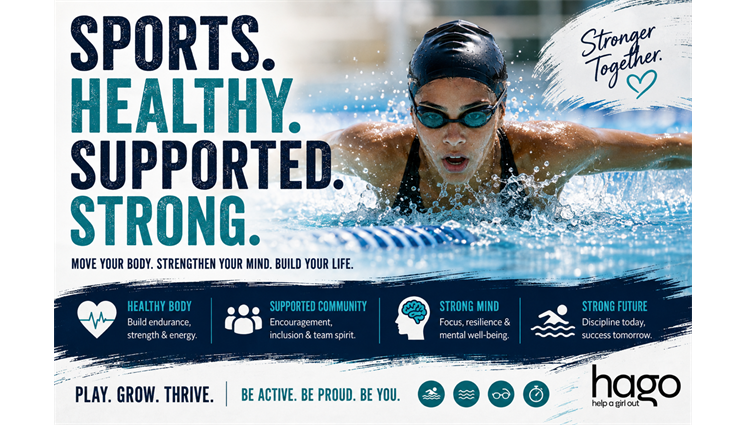
For a long time, athletes have been taught to push through. Push through the pain. Push through exhaustion. Push through discomfort. Push through anything that might stand between you and the finish line.
But what happens when the thing we are being asked to push through is something we have been taught not to talk about?
For many in sports, menstruation has been one of those things.
We have competed while bleeding. We have trained through cramps. We have worried about leaks in swimsuits and uniforms. We have learned to calculate when our periods might arrive before a competition. We have quietly carried pads and tampons in our sports bags.
And sometimes, we have simply hoped nobody would notice.
I know this because I was once a competitive swimmer.
When I was young, I competed at the national level. I loved swimming, the feeling of being in the water, the discipline of training, and the excitement of competition.
But there was another reality that I didn’t know how to talk about. My period.
Because of the stigma surrounding menstruation, I never felt comfortable talking about it during training or before a race. There was no conversation about whether I was having cramps, whether I was unusually tired, or whether my period was affecting how I felt in the water.
We were girls, but we were expected to be athletes first. And when it was time for competition, we were pushed into the pool.
We survived. But looking back, I don’t think young athletes should simply have to survive. We should be creating an environment where they can thrive.
Is it normal to miss your period as an athlete?
This is an important question — and one that deserves more attention.
Some athletes experience irregular periods or stop menstruating altogether, particularly when training demands are high and the body isn’t getting enough energy to support both everyday functions and athletic performance.
A missed period isn’t necessarily something to panic about, but it shouldn’t automatically be celebrated as a sign that an athlete is “training hard.”
A menstrual cycle can provide important information about an athlete’s overall health. When periods become very irregular or disappear, it can be a sign that the body isn’t getting enough energy relative to the demands being placed on it.
That is where RED-S comes in.
What is RED-S?
RED-S stands for Relative Energy Deficiency in Sport. It occurs when an athlete’s energy intake is not sufficient to meet the demands of training and the body’s normal physiological functions.
And it is about much more than periods. Low energy availability can affect multiple systems in the body, including reproductive health, bone health, immunity, metabolism, cardiovascular health, and psychological well-being.
For female athletes, menstrual changes can be one of the visible warning signs. This is why a missing period shouldn’t simply be dismissed with: “You’re an athlete. That’s normal.”
It may be a signal that deserves attention.
Your period is not a weakness
One of the biggest problems is the message young athletes can receive from the sporting world. Being tired means you’re committed. Being in pain means you’re tough. Training harder means you’re better.
And talking about your period? That can feel like admitting weakness.
But menstruation isn’t a weakness. It is a biological process. And having a period doesn’t make someone less athletic, less disciplined, or less capable of competing.
We need to separate the idea of mental toughness from the idea of silently ignoring what your body is telling you. An athlete can be incredibly strong and still say:
- “I’m having severe cramps today.”
- “My period is affecting my energy.”
- “I think something has changed with my cycle.”
- “I need help.”
Those aren’t signs of weakness. They’re signs of body awareness.
How can menstruation affect athletic performance?
Menstruation and the menstrual cycle can affect athletes differently. Some athletes notice changes in energy, mood, sleep, appetite, body temperature, cramps, gastrointestinal symptoms, or perceived exertion at different points in their cycle.
For some, symptoms are barely noticeable. For others, they can significantly affect training and competition. And that variability is important.
There isn’t one universal “best” phase of the menstrual cycle for every athlete, and we shouldn’t create another pressure for girls to perform according to a rigid menstrual-cycle calendar.
Instead, athletes should be encouraged to understand their own bodies. Tracking symptoms and menstrual cycles can help an athlete identify patterns and communicate more effectively with coaches, parents, doctors, physiotherapists, nutrition professionals, or other members of their support team.
The goal isn’t to make menstruation another performance metric. The goal is to make it something athletes can talk about.
What happens when we don’t talk about it?
I think about my younger self in the pool. I remember the pressure of competition. The training. The expectation to perform. And the unspoken rule that certain things simply weren’t discussed.
We girls were expected to get in the pool. So we did. We learned how to manage our periods quietly. We learned not to complain. We learned to carry on.
And perhaps that is one of the biggest lessons I took away from being a young athlete: girls can be incredibly resilient. But resilience should not be an excuse for adults to ignore their needs.
Just because we managed doesn’t mean the system was supportive. Just because we survived doesn’t mean we should accept the same experience for the next generation.
Coaches have an important role
Coaches can make an enormous difference. A coach doesn’t need to be a medical expert or know everything about menstruation. But they can create an environment where it is safe to talk about it.
Imagine if a young swimmer could tell her coach: “I have really bad cramps today.” And instead of embarrassment or dismissal, the response was simply: “Okay. Let’s figure out how we can support you.”
That small change can be powerful.
Coaches can also learn about menstrual health, RED-S, nutrition, overtraining, and the warning signs that may indicate an athlete needs additional support. Most importantly, they can stop treating menstruation as something shameful.
Parents need to be part of the conversation too
Parents can help normalize these conversations at home. Talk to young athletes about their periods before they have their first one. Make sure they have menstrual products in their sports bags. Ask how they are feeling — not only whether they won their race.
And pay attention to changes. A daughter who suddenly stops getting her period shouldn’t necessarily receive praise for being “so fit.” She deserves to have someone ask why.
We need to teach girls that their health matters just as much as their performance.
We also need better support in sports
This isn’t only about individual athletes. Sports organizations have a role to play. Schools, clubs, teams, coaches, athletic federations, and competition organizers can all help create environments where menstrual health is considered part of athlete health.
That can mean:
- Access to menstrual products.
- Private and clean changing facilities.
- Reasonable bathroom access.
- Education for coaches and athletes.
- Nutrition support.
- Clear pathways to healthcare professionals.
And, perhaps most importantly, a culture where talking about menstruation isn’t embarrassing.
For swimmers in particular, there is another layer to consider. When you’re competing in a swimsuit, the fear of a visible leak can be enormous. A young athlete may be worried about getting into the pool while menstruating, asking to leave the pool, or having an accident in front of teammates and spectators.
Those fears are real. And they can be incredibly distracting when an athlete is supposed to be focused on the race.
We need to stop glorifying “pushing through”
There is a difference between overcoming a challenge and ignoring a health concern. Athletes will always have difficult days. They will have sore muscles, nerves before a race, disappointing results, and moments when they have to dig deep.
But we should not teach young athletes that being a good athlete means ignoring every signal their body sends them.
Sometimes the strongest thing an athlete can do is speak up. Sometimes rest is part of training. Sometimes asking for help is part of being disciplined. And sometimes a missed period isn’t an inconvenience to work around — it is information that deserves to be understood.
We survived. But the next generation shouldn’t have to just survive.
When I think back to my years as a national swimmer, I feel incredibly proud of what we accomplished. We trained hard. We competed. We pushed ourselves. We supported one another. And yes, we survived the things we didn’t have the language or confidence to talk about.
But I also think about how different it could have been.
- What if we had been able to talk openly about our periods?
- What if a girl could tell her coach she was struggling with cramps without worrying that she would be seen as weak?
- What if menstrual products were simply available in every sports facility?
- What if coaches understood that a missing period could be a warning sign?
- What if girls were taught that fueling their bodies was part of being a strong athlete?
- What if menstruation was treated as a normal part of sports health rather than an embarrassing inconvenience?
I believe we can do better.
Let’s change the conversation
Our daughters deserve to grow up in sports environments where they don’t have to choose between their health and their performance. They deserve coaches who listen. They deserve parents who ask questions. They deserve teammates who don’t shame them. They deserve access to menstrual products. They deserve proper nutrition and healthcare. And they deserve to understand what their bodies are telling them.
Most of all, they deserve to know that having a period does not make them less of an athlete.
I was once the girl who got into the pool and didn’t talk about her period. Today, I want to help make sure the next generation of girls doesn’t feel that same silence.
We survived. But survival shouldn’t be the standard.
Let’s create sports environments where girls can be healthy, supported, confident — and strong enough to speak up. Because the goal isn’t simply to get girls to the starting line. It’s to make sure they can get there healthy, informed, supported, and proud of the bodies that got them there.
Written by Tanya Ozkan-Saran